

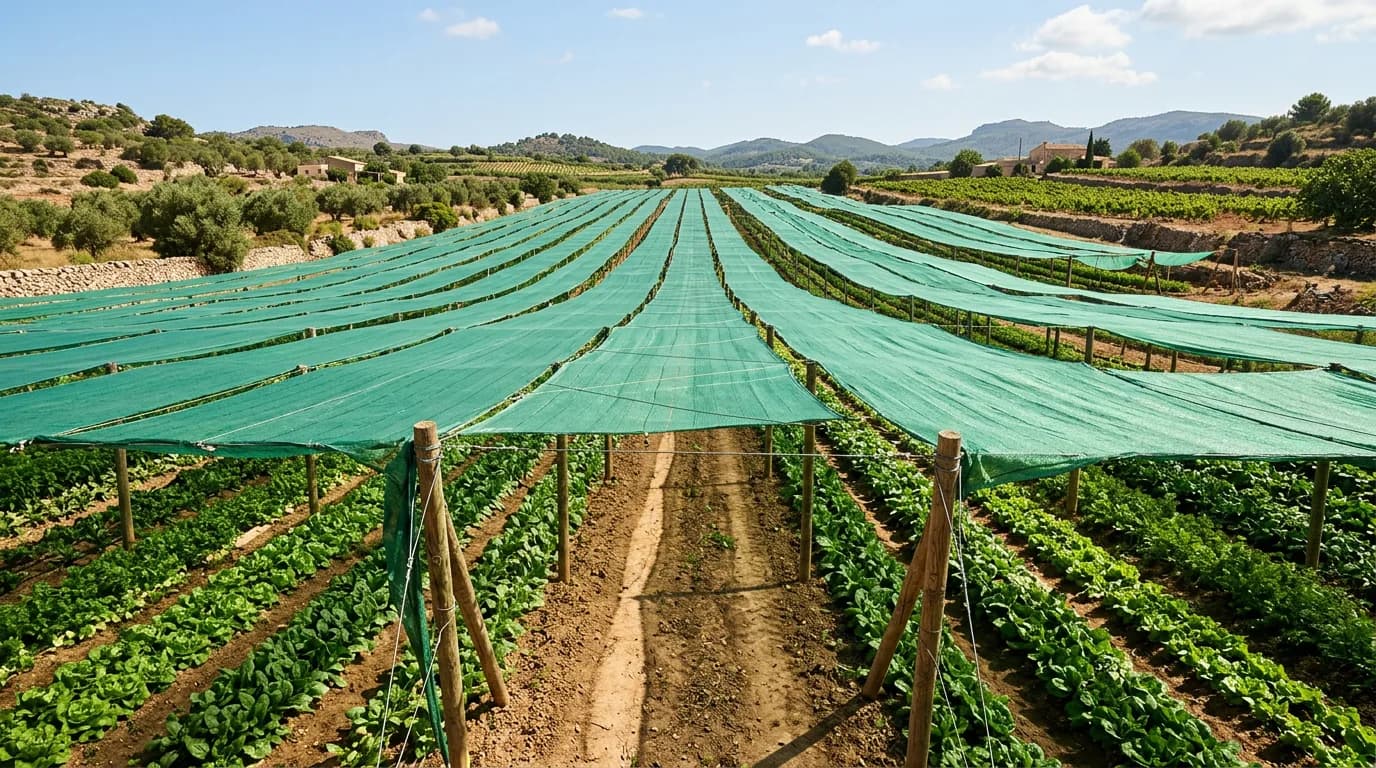
Shade netting is an essential tool for regulating temperature and solar radiation in crops sensitive to excessive heat.
In this guide we explain how to choose and size a shade installation for the best productive results.
Shade percentages and applications
Shade nets are classified by their light reduction percentage, ranging from 30% to 90%. The correct choice depends on the crop type, latitude and time of year.
For leafy vegetables, 30-50% shading is usually sufficient. For ornamental crops or nurseries, 60-80% may be needed.
The influence of mesh colour
Mesh colour affects not only the shade percentage but also the light spectrum reaching the crop. Black meshes provide maximum shade but reduce light uniformly.
Coloured meshes (green, red, blue) selectively filter specific wavelengths, stimulating particular physiological responses in plants.
Installation height and ventilation
Installation height directly influences air circulation under the structure. A minimum height of 2.5 metres above the crop is recommended to allow natural convection.
Adequate ventilation prevents the build-up of excessive heat and humidity under the mesh, factors that can promote the onset of fungal diseases.